Tuesday, December 14, 2010

Nissan Leaf

The world's first Nissan Leaf arrived on United States soil this past weekend, and it is said that the Leaf is the beginning of the end for gas-powered cars.

The Leaf was preordered by over 27,000 people, and for good reason. In addition to the ability to accelerate to speeds upwards of 90 mph, unusual in electric cars that don't have the name Tesla on them somewhere, the Leaf has comfortable seating, electronic panels that explain just how much of a carbon footprint you're leaving as you leave it, an ipod application in the works, and numerous entertainment abilities for families and the bored commuter. It even has a pedestrian warning, and, possibly most important of all, it's affordable and will cost 15% less annually to upkeep than a regular car. 
   The design of the car is what catches people, as it's a bit snazzier than Nissan has been in the past, and therefore a bit more futuristically attractive than most people thought it would be. 

Industrial Design at its Finest: Johnathan Ive

Jonhnathan Ive is the Senior VP of Industrial Design at Apple. He has been the head of all of the great creations at Apple from the PowerBook G4 to the current iPhone design. He is absolutely amazing.

Chermayeff & Geismar logos animation

I don't think I've seen anything like this.
This is a great way to show how connected logos are as well as the unique characteristics in them. his video can teach you a lot about designing a logo.


Interview with the man behind the FedEx logo via thesneeze.com


When did you design the logo?

1994, as Senior Design Director at Landor Associates, San Francisco.

Has the logo won many awards?

To my knowledge, over forty worldwide and they continue. In its May 15, 2003 35th Anniversary �American Icon� issue, Rolling Stone Magazine ranked it as one of the 8 best logos of the past thirty-five years. Along side Apple, Coca-Cola, Nike, IBM, Starbucks, McDonald�s and Playboy.

Is this the most �famous� logo you have designed?

In terms of sheer ubiquity, absolutely. Though the logos for Ryder trucks, CIGNA, the NCAA and Latin America�s largest bank, Banco Bradesco (Sao Paulo, Brazil) are familiar in their own right.

Do you get free FedEx deliveries for life now?

I wish. But I did get a once-in-a-lifetime opportunity to command an MD-11 flight simulator at the Memphis hub. Unfortunately, I crashed the plane into the sand dunes at LAX on approach from Hong Kong. Nobody hurt, though.

At what point in the design process did you realize you could create an arrow with those letters?

First of all, by the time we�d gotten to this point we�d already created and reviewed over 200 designs; some close-in to the �old� Federal Express logo and others progressively more daring (though all the while retaining the enormous cache of the famous orange and purple (despite the fact that many respondents in focus groups thought the Federal Express colors were �red and blue�). The current design was one of six semifinalists that were being refined for a presentation to very senior management.

If you put a lower-case �x� to the right of a capital �E� (Ex) you can begin to see a hint of an arrow, though it is clumsy and extremely abstract. I thought that, if I could develop this concept of an �arrow� it could be promoted as a symbol for speed and precision, both FedEx communicative attributes. And, by the way, different kinds of arrows were utilized with some of the other semi-final candidates, though none of those were �hidden.�

Once I decided to refine the concept of the embedded arrow, I found that, to make the arrow more legitimate and identifiable, one needed to actually reconstruct the letterforms in order to make the arrow happen. This leads to your next question:

Did you have to manipulate the font in anyway to create a perfect arrow?

Yes, indeed. I was studying Univers 67 (Bold Condensed) and Futura Bold, both wonderful faces. But each had its potential limitations downstream in application to thousands of FedEx media, from waybills and embroidered courier caps to FedEx.com and massive signage for aircraft, buildings and vehicles. Moreover, neither was particularly suited to forcing an arrow into its assigned parking place without torturing the beautifully crafted letterforms of the respective faces. To avoid getting too technical here, suffice it to say I took the best characteristics of both and combined them into unique and proprietary letterforms that included both ligatures (connected letters) and a higher �x-height,� or increased size of the lower-case letters relative to the capital letters. I worked these features around until the arrow seemed quite natural in shape and location.

Why choose to keep the arrow so subtle? It seems to show remarkable restraint. Weren't you or the people at FedEx ever tempted to make it more obvious with an outline or a different color?

A good question and one that I am frequently asked. An arrow, in and of itself, is one of the most mundane graphic devices in visual communications. Truly, there is nothing unique or particularly strategic (marketing-wise) in using an arrow as a brand identifier. Early on, before the brand rollout in mid-1994, FedEx�s public relations agency was preparing to emphasize the arrow as a secondary graphic to underscore the �speed/precision� positioning. They proposed to leverage this in their FedEx communications. Landor put its foot down and said, �No way.�

The power of the hidden arrow is simply that it is a �hidden bonus.� It is a positive-reverse optical kind of thing: either you see it or you don�t. Importantly, not �getting the punch line� by not seeing the arrow, does not reduce the impact of the logo�s essential communication. The power of the logo and the FedEx marketing supporting the logo is strong enough to convey clearly FedEx brand positioning. On the other hand, if you do see the arrow, or someone points it out to you, you won�t forget it. I can�t tell you how many people have told me how much fun they have asking others �if they can spot �something� in the logo.� To have filled in the arrow, or to somehow make it more �visible� would have been like Henny Youngman saying �Please take my wife� instead of �Take my wife. Please.� Punch lines that need to be explained are neither funny nor memorable.

Is there anything else interesting about the creation of the logo that you can remember?

Well, in �selling� an identity into a company it always comes down to the CEO. Fred Smith is a marketing genius and understands the vital role of design in brand building. A smart, intuitive man. After a year of worldwide focus groups and brand strategy revitalization, Mr. Smith accepted the strategy to change the communicative name of the company from Federal Express to FedEx for a whole host of reasons I won�t get into here.

In authorizing us to commence the next phase of developing a graphic identity for this �new� name, he sent us off with these charges: 1), �If you come back and tell me our colors need to be pink and green just give me very good reason to do it and 2), �If I�m standing on a street corner, I need to see a FedEx truck from five blocks away.� Meaning that the brand expression needed to be large, impactful and differentiating, which was accomplished with this specific design system, one of five presented to Mr. Smith and his executive team on April 23, 1994 in Memphis. And, in the process, we made the orange more orange and the purple less blue.

What separated this candidate from the others? Among other reasons,
Mr. Smith was the only executive in a room of 12 that spotted the arrow right away.

Are you like a rock star in the world of logo design now?

Well, we Fortune 1000 identity guys and gals are behind the scenes most of the time. We do get our individual recognition from design competitions, but generally speaking, the design public only hears of the branding firm that created the design; in this case, Landor Associates. And the public at large doesn�t know who designs something or even cares to know. So, these days you won�t find me ducking crowds screaming for my autograph. No.

Have you ever been asked to autograph a FedEx truck?

I�ve never been able to find a Magic Marker big enough for the job. But I have signed FedEx letter envelopes and boxes. And, of course, my autograph is on my monthly check to FedEx.

What's it like to see something you came up with, all over the place?

Fabulous. And very gratifying. It takes me back to my very first employer out of Art Center in Pasadena, the renown Los Angeles designer Saul Bass. Toward the end of his career in 1980 or so, an interviewer asked him if still got out a thrill out of it all after some 40 years and a million awards in the corporate identity and film industries. Saul said he had been in a car one day recently with his 5 year-old daughter who exclaimed, �Look Daddy! There goes one of your [AT&T] trucks!� And Saul said to the interviewer, �You know, seeing that truck coming down the road still makes me proud after all these years.�


http://www.thesneeze.com/mt-archives/000273.php
I have to talk about this new video from Dr. Dre featuring Snoop Dogg and Akon. I love the concept of it. The main performers are moving through a world and not really being part of if. I feel like this is a love or hate it idea. I love it!

Weird Bike. Cool Concept.


Sam Dunne writes

"Taking a lot of inspiration from those funny three wheeled scooters and high-speed tilting trains, design graduate Berk Asal came up with the "Triblean" retrofit kit as part of his thesis work.
Berk's addition to the bicycle retrofitting world transforms an ordinary road bike into a rather peculiar 3-wheeler that, on top of being a comfortably stable ride, allows the cyclist to lean into corners for maximum speed and exhilaration."


I'm sorry but everything "peculiar" isn't necessarily great. I can lean into my bike comfortably with little space and be just fine. This third wheel seems rahter unnecessary for practical use. Still, a great design.


TRON-inspired skateboard

Since I was a kid, I've always loved the movie "Tron." I was one of my grandfather's favorite films and we always watched it. I never quite understood the plot, but the idea that there were people living in a game console was enough to hook me. He loves sci-fi movies and I am so happy to see the sequel with him in theaters.

Alon Karpman has apparently dug into his own childhood love and has come up with a new skateboard inspired by the new film. What does he do with it? Parade around the city of course! He's the man! It took him many hours and plenty of prototypes to run through before he came up with his own legacy. I hope Disney buys the product from him for mass distribution. This goes to show you hard work and creativity pays off.


Sound Art

     There is a prize given yearly in London called the "Turner Prize", given to one artist who pushes the boundaries of contemporary art, in new and exciting ways. While the prize is often made fun of by others who mimic the art with found materials in their own homes (as it tends to be easy to recreate), this year is a bit different and has generated a buzz in the art world.
     The reason for that is that the winning work is sound art. There is no visual aspect of the art at all; instead, "viewers" sit on benches or stand around and listen to the artist, Susan Philipsz, singing old Scottish laments through hidden speakers. People are applauding this choice, as they say that music is art too and should be awarded for touching the spirit of the listener in a new way.


     It begs the question of whether there is a need to separate the two fields: If music is art and art is music, will paintings be competing with Beethoven somewhere down the line?

Architect's Coffee Table

Australia-based designer John Leung has combined forces with CHC Architects to produce this stunning Carp-pet" rug and table set. The design is absolutely mind-blowing and awesome. It combines distorted images of fish and and a coffee table made of bars to give the illusion of movement. Check out the video!


Monday, December 13, 2010

Design Schools Need to Teach More

Core 77 posted an article by Don Norman on the need of design schools to teach more than just design. It is common knowledge that a good designer possesses T-Shaped skills. That means that they don't specialize in one particular thing; they have a grasp of many different things and many different fields so they have a bigger base of knowledge to draw from when creating designs for a client.
Norman argues that most designers these days actually don't possess those skills. He says that they tend to submit "crap" that demonstrates a complete lack of knowledge about things outside of the design field. The problem lies in an inability to interact positively with other people. He says that design schools need to focus less on drawing and other aspects of the art world and instead need to focus on human behavior, processes like the scientific method, and statistics.
This brings to light the fact that a designer needs, extremely, to understand the people he or she takes on as clients. One can be the best designer in the world, but if you don't understand what people want/need, you can end up never getting the jobs you want. It's a very important point that is too often overlooked. Norman also raises the point that before students can be educated in new ways, professors need to be taught. Part of the problem is that the professors teaching the students don't know the new ways either.

Smithsonian Show Controversy

The New York Times ran a story about a show at the Smithsonian. Apparently a part of it was taken down because some high-ranking Christian officials and Republican politicians found it offensive, as one of the videos depicted ant crawling on a cross. Because of this, the Warhol Foundation has threatened to stop funding the Smithsonian completely if they do not put the work back up.

It's obvious that there's a certain amount of censorship going on here, and my first instinct is to agree loudly with the Warhol Foundation and take artistic offense. The act of removing the work sets a bad precedent for future art that can be deemed offensive, and I'm glad that the Warhol Foundation is against such things.
However. I have to question the common sense of removing all future funding because one work of art was taken down for offending some people. What about all of the other artists who want to show their work at the Smithsonian, and would only be able to do so with funding from the foundation? The group calls this particular piece an important work of art, and I wonder if they assume that justifies throwing all other shows aside. It doesn't seem fair, and it ends up turning the entire thing into a question of how interconnected one artist is to another.

Sunday, December 12, 2010

Design Constructed for Deconstruction

     Core 77 ran a story on designs of everyday items meant to be disassembled in case something goes wrong. This is extremely interesting because I think there is a certain amount of self-assurance in the design world that isn't often addressed. Designing something with the mindset that someone, someday, may have to take it apart involves admitting that it's likely that something is going to go wrong. It's called the "Design for Disassembly" strategy, DfD for short.
     Design for Disassembly came from a sustainability issue that the government brought attention to: the amount of waste we produce. People began to consider recycling something that would become more of a necessity as the years pass (and they were right). To answer this necessity designers began making things that could be taken apart and repaired or turned into something new (think: recycled without actually getting rid of it first), eliminating the need to throw a broken appliance out immediately. 
     There are some problems with creating DfD designs, such as the cost-effectiveness of creating something that's meant to be taken apart. It means a lot more seams and nails, for one thing. Additionally, Design for Disassembly is a strategy that needs to be taught to each person involved in the design process. That takes time, although it seems worth the effort if it saves something useful from being tossed away. 

Social Designers

     Browsing on Core77 brought to my attention the words "Social Designers" in the title of an article. The article is about an exhibition that happened in August at the Abrons Arts Center on the lower East Side (an arts center that showcases performances, artists, and training for young people). The exhibit uses research to ask the question of whether design could be used to change the basic ways in which we associate with each other. The show used "examples of people who have taken it upon themselves to innovate new ways of resourcing their everyday lives" to do this, almost as case studies. It then attempts to see if design knowledge could increase their productivity and ease of life.
     Basically, the idea is that design is more than a talent or a hobby but a mindset and a lifestyle. While at times the "designer mindset" can seem imposing (say, when something that doesn't need to be replaced by a minimalist wall of glass is replaced for the sake of "upgrading"), it might be useful if ordinary people thought like designers, at least some of the time. This brings back to the table the idea of T-Shaped skills, that designers have to know more things than most people. The exhibit also looks at creative communities in an effort to see if they're actually worthwhile for those who live there.
   It nothing else, the exhibit was certainly a very interesting merge of science and art.

Sustainable Design

   It's always interesting to consider what the designer of a given product was thinking when he or she created the design. Sometimes their minds are on sustainability. For green-minded designers like that, some educators are encouraging their students to consider using materials that are environmentally efficient. As reported by Core 77, teachers of design are beginning to notice the need for environmentally friendly teaching. Students should be taught ways to cater to the needs of the client without destroying the land we live on.
     It's a very timely concept, as a lot of focus lately has been on the sustainability of current practices, particularly in the United States. Apparently this concern has trickled down from the users of the products to the people who design them. It's an easy turn of the mind to think that the best environmentally friendly plans start with the people who design the products in the first place. It eliminates even the option of polluting the earth if the designer chooses to use only biodegradable materials, for example. Students are taught that they have a say in what happens to the world, and are encouraged to use that through the teaching of simple sustainability practices of design.

Mood Calendar

Remember those mood calendars from years ago? The ones that would allow you to pick an emoticon per day, one that was meant to tell others what your mood was like. Spanish design company Brigada Creativa designed a calendar that puts the emoticon in the hands of the user, allowing them to draw in a face that they think describes their mood.
 It can be a little confusing as it at first merely looks like a large page of yellow dots, but eventually it becomes a fun thing to do as one pencils in faces every day. There's no particular point to it besides the personal entertainment of charting your own moods, but it's rather interesting anyway. It puts a spin on the classic mood calendar and allows a person to get hands on with it.

The Nautilus Mobia

Core77 posted an article today about the Nautilus Mobia, a treadmill designed to fit better in the home. The standard treadmill is one of these :

Boring, militant, at home only in a room full of other boring, militant machines, but not in personal quarters. The Nautilus Mobia was created with the help of Core 77, and they recorded the entire process. That in itself is interesting because it is rare to see a design process from conception to physical creation. It takes the average person into the mind of a designer, starting with the key ingredient of identifying a problem that needs to be solved or a need that has to be fulfilled.
     They started with  a problem, in their case the fact that the average treadmill doesn't have a design that fits into the home, despite the fact that a lot of people use them in their houses. They first created a concept to respond to this need by turning the treadmill into a smoother, more sculptural object. The objective of creating the piece was to hide its no-nonsense function. This led to other changes, such as making the readout one that disappears when the treadmill isn't in use. They turned the treadmill into this:
Then went on to describe the process of making it affordable for consumers. The story is definitely worth a read, not just for those interested in design, but for those interested in how some things get user-conscious upgrades.

Blackberry Empathy Concept Phone

Sometimes looking at gadget websites is the way to see what artists are up to. Concept designers such as Kiki Tang and Daniel Yoon put their minds to work bringing to breathing new life into things such as cellphones and cars. Hence, the Blackberry Empathy concept.

     The phone, in my personal opinion, isn't very nice to look at, trying entirely too hard to be futuristic in its resemblance of a shard of very thick crystal. It turns from black to clear when not in use, which is interesting, but the buttons look like they'd be hard, at best, to push.
     The idea behind the phone is the real attention-grabber. It comes with a ring that one can choose to wear or not (the phone will work regardless of whether you have the ring on your finger) that senses the mood of the wearer. It also senses the mood of other people in the room who are also wearing the rings, and lets one know if they're in a mood for conversation or not. While this seems less like an advancement in technology and more like a step in the disturbing direction of doing away with a simple "how are you?", it's an idea that hasn't come before.

Monday, November 15, 2010

Exceptional Person!

At the Viridian Gallery in Chelsea, I met the artist Arthur Dworin
His work drew me into the small gallery space, and after reading his biography, I felt that I'd stumbled across an exceptional person. Arthur is a painter of large huge!) scale abstract art that focuses on color use. He wants to inspire feelings in the soul of the viewer, and he hopes to inspire feeling in himself as he does the work. Dworin is a kind man, and he came by with a handshake and a helpful chat the second I entered the room. He's painted sets for Broadway shows (and belongs to a union of theater designers), shown his paintings internationally, drew illustrations for the New York Times, worked at the MOMA, and painted movie sets. His specialization is faux finish wood, and the frames on his paintings on display in the Viridian gallery were faux wood. I didn't know it until he pointed it out and insisted I take a look. Even up close they seemed like real wood. 

He ended up doing all of the things he has, including knowing how to paint fax wood finishes, by practicing. Working on theater sets often required making things look real when they weren't, and he perfected his skill by working on them from a young age. Dworin stressed the idea of each work of art being the result of a lifetime of work; all experiences add up into the next. He used the people he knew to join galleries, and has been designing sets for 20 years. Painting is his passion but sets put food on the table. He was willing to do any job, even doing illustrations in the New York Times as a favor to his friend, the Creative Director. 
His tips on how to become his type of professional (a successful artist) are pretty straightforward. DO your work was the first one, as he doesn't think many people realize just how important it is to simply finish work carefully and completely. He then said that it is necessary to build a body of this work, so that it can be displayed, photograph the work, and then make sure that as many people see it as possible. He praised the use of social networking sites like Facebook and free website makers like Wix.com, saying that it made it that much easier to get noticed. He used his Facebook to advertise his website, then got hits on the website that way. It was smart, intuitive marketing that got him where he needed to go. He also adds that it's important for artists to know other artists who have gotten into galleries, as it not only keeps you abreast of the happenings of the moments, but it gives you people who can recommend you to galleries. Like Victoria Monsul said, get comfortable with telling people about your interests and showing them your work. 
Lastly, Dworin said his most important sentence: Have passion. Without passion, the work loses something of itself, and one would have a very hard time getting anyone else to care about it. One fails a lot on the road to success, and sometimes the passion is the only thing that can keep you going.

Victoria Monsul : Post Graduate

Post-graduate Pratt student Victoria Monsul came to class to talk about life after college, and the things that she did to find success. Monsul graduated in 2007, and because it was so recent, she's the perfect candidate for the tough job of relating life after to people still in school.
The presentation was a little all over the place, but that's because Victoria's life was a little all over the place. She taught the room many things, but the one point that I came away from the presentation with was that sometimes it takes a while to find one's niche, but all the experiences leading up to it are  learning experiences.
She posed the questions of "how do we become who we are? Who am I? Who are you?" Who she was was defined by what she wanted out of life after school. She didn't know what she wanted to do, only that she wanted to be surrounded by like-minded people in a creative environment. Victoria accepted that as a part of her, because she believes that being true to oneself and authentic is an important part of understanding yourself and other people. Understanding other people is a key ability that successful people possess. She was selective about who she chose to be her friends, knowing that friends can either help or hinder you, and she was open with her passion for whatever she was doing.
Monsul covered the benefits of having a degree, something that college students often overlook. It isn't just a piece of paper: it gives one a leg up on the competition, and school itself builds the kind of confidence that you can't find anywhere else. It also teaches one to deal with critiques, both helpful and useless. Degrees open doors, but confidence is what compels people to actually do things once those doors are open.
Over the course of the lecture, Victoria pointed out the importance of networking, even if she wasn't directly speaking of it. Her first job, her second job, her third, her internships all came to her by speaking to people. Everything important started with a casual connection. Sometimes merely saying hello and leaving your information is enough to get you in the door later on down the line. She stressed that it's important to get comfortable talking to people about your interests, so they know what you're capable of and what you love doing. One must learn to leave their comfort levels behind, just open doors and pop in to say hi.
The most important and poignant part of the presentation was when she said "You must learn how to fail, guys." That's key to anything that one wants in life, failing and learning to pick yourself up and keep moving despite that failure. It was a good point to end on.

Sunday, November 14, 2010

Agent Anything

     I was on the train, looking at advertisements when I saw one for Agent Anything. The banner left much to be desired in the way of information (beyond something along the lines of "our agents do anything!"), so I came home and checked out agentanything.com. Apparenty this company saw a need for more time or at least another pair of hands in the lives of most working New Yorkers, and decided to fill it. With college students. 
People who need help post errands on the website, and college students (who have signed up with a valid college email address) can run the errands, confirm that it's done, and get paid directly through their email. It's a creative idea, and they post requests for anything from dry cleaning to someone who can help them build a website.
     It probably doesn't have much to do with design, but it was certainly interesting. It could be an interesting method of obtaining freelance design work, since all of it is on a computer anyway. Perhaps one could create a design and be paid for it via paypal. 

Thursday, October 14, 2010

Physicality!

     Today I read an article on Core77 about the Apple iPhone 4. It wasn't your standard "omg the iphone is so greeeaaaat, look at all these apps" fodder, but rather, it was about the physical properties of the thing. IT was interesting not only because it was an unusual look at the iPhone, but because the article addressed issues in the design world about the need for designs to not only look good but to feel good.
     The writer of the article said that he was surprised by the iPhone the first time he took it out of the box, despite the fact that he had seen it online and in ads, on television and in YouTube before. For him, that is an important thing that Apple has managed to grasp. The iPhone, yes, does many wonderful things and has two cameras, etc, etc, but it's also slim and attractive. It's a rectangle that appears to lack anything interesting at first glance, but once you get closer and pick it up, you see the various design nuances that make it so well crafted and appealing.
     There's also a look at the creation process of the iPhone:

     Interesting!!!

Monday, October 11, 2010

Design returns to its roots

     What drew me to this post in the New York Times was not the title but the tagline: "...remarkable design projects that fulfill the old-fashioned objective of improving our quality of life". 
It isn't something that seems to be thought about often, and is seldom acknowledged in the plain, honest way that this article does it. 
     The subject matter itself is interesting, as the article covers everything from oval plates to well designed books. It serves as a reminder to the consumer and the close-knit design community alike that design exists, sometimes well hidden, in every facet of our lives. It's nice to see that some designers are still pursuing things that don't seek to particularly excite or create controversy, merely to simplify in the same way that wheels on a suitcase changed the luggage industry. More design should be less about "how can I dazzle my consumer" and more about "what does my consumer need?" Apple is a prime example of a good balance of the two, as they have been demonstrating since they unveiled the Ipod years ago. Yes, it was streamlined and meant to attract attention, but it also served the purpose of being a large-storage mp3 player that allows one to actually see the music they've stored, something the consumer definitely needed. 

Anna Akbari!

     Today we had a presentation from Anna Akbari, a sociologist and designer of the personal image. She began her presentation with an interesting question about authenticity, namely whether there even is such a thing, and if so, whether or not authenticity is relevant in today's world.
     Akbari argues that because we all wear masks all the time (when dealing with different people, say at home or at work), all of the masks are authentic because they come from ourselves, the authentic original. "Appearance is authentic", meaning that if you appear a certain way, to the world around you, that is who you are, authentically. Our 'backstage' and 'front-stage' lives are dictated by how the world sees us, even if it's just during a glance in the mirror in the morning to see how we look. The emphasis of Akbari's presentation was not on how we see ourselves but on how the world sees us, which is far more important when 'pimping' oneself.
     It is easy to draw the conclusion that Akbari is suggesting that part of the foundation of presenting yourself the way you want the world to see you is by misleading your audience. This is not true, as completely misleading your audience is not only kind of childish, it's difficult to maintain, BUT it is true that part of our lives is spent misleading others, at least some of the time.The idea is to lead your audience the way you want them to go, skirting completely misleading them and instead putting your best self forward. The pace to start is by picking something that you feel defines you, then building a concrete personality around that. "Feel free to play around with your possible self".
     Akbari then went on to talk about "transcending your biological self", as well as how one is to do that. Like changing your name to make it catchier, transcending your biological self is all about not letting who you are on paper define who you are out in the world. Some tips for doing that are:

  • If you plan to have multiple persona, manage them properly. Always know which persona works where, and where is isn't okay to project a certain image. As in, don't act the way you act in a bar with your friends.. at a job interview.
  • Track your own image! While you're physically somewhere else, your image is out in the world working for you at all times. With the internet being as easily accessible as it is, chances are, someone is always looking at the image you've created elsewhere. Be aware of that.
  • Think about the different directions your identities can branch off in. This connects back to the idea of having "T-shaped' skills in the workplace. If you can paint, draw, and act, don't limit yourself to one thing. Look for opportunities to combine what you do. Anna uses her flair for fashion and her knowledge of sociology, for example, to run a wardrobe consultant service called Closet Catharsis.
  • Lastly, consider creating an avatar on Second Life or something similar, as it will give you a chance to test out being exactly who you want to be, even if it's a different race or sex. It's a unique opportunity to test drive a different personality. 
     Akbari began to wrap up her presentation with the steps necessary for pimping yourself. This includes creating a timeline of your intellectual lineage (where did you go to school?) as well as your professional pedigree (where have you worked/what are you qualified to do?), learning to think, write, and speak extremely well, and combining all of that with strategic self presentation. This is what gets people hired in the working world. She also stresses the importance of networking, and mentions that a personality can be entirely augmented by developing an entrepreneurial spirit. This doesn't mean you have to make your own business fresh out of college, but it does mean that you should know to use what you already have to make a place for yourself in the world.

So:
Identity is fluid,
Creativity trumps biography,
Authenticity is irrelevant,
Design is embodied (design who you are),
and Live a networked life. 


I plan to "go forth and pimp" myself.

Monday, October 4, 2010

Experimental Portraiture!!

     Experimental Portraiture is a section of art that seeks to capture the spirit of a subject beyond simple facial capture. Experimental portraiture has been around for a while, coming about in the non-visual portrait creations of writers like Gertrude Stein. Science and psychology also played a role in the development of experimental portraiture, as researchers like Sigmund Freud began to study personalities and what defines a person. Artists, often taking their inspiration from what changes in the societies they reside in, caught this "personality bug" and began to do studies of their own, pushing themselves and their work to copy those studies and really get at the heart of their subjects.       
     Experimental portraiture can be made in a variety of ways, such as with paint, as is demonstrated in the work of Stephanie Schmitt. Schmitt paints portraits of people, focusing on facial expressions and the emotions behind them. She overlays various views of a subject, resulting in an almost ghostly image, full of movement and action. She most specifically seeks to capture not only one emotion, but several, as well as the shifts between them. The result is the aforementioned overlaying of faces. She paints realistically in 3 dimensions, because she thinks realism is integral to what she's trying to capture. 
Untitled, Stephanie Schmitt, 2005
     Other artists use photo manipulation to create their work, such as in the art of James Honzik, an exerimental artist from the west coast. He makes photographic collages, often overlaying images of models on images of corrosion, such as rusty school buses and the like. Honzik likens his subjects to things found in nature, such as the moss of a tree, seeking to define the person in the portrait by these things. Through his work, he is attempting to discover what makes a person captivating, or powerful, or just plain interesting. 
Crown of Rust, Dress of Stone, James Honzik, 2007.

Tuesday, September 21, 2010

Three Dimensions!

This week, the New York Times ran a story on the ways that three-dimensional printing is changing the manufacturing industry. This technology, which prints layer upon layer of plastic (stacking them to create one three dimensional object in the same way that one sticks post-its together to make a block) to make anything from prosthetic limbs to cellphone cases, has been around for a few years. It is, however, seeing advances that simplify it and make it even more accessible to the public, such as faster print speed and cheaper processing costs. The Times aptly puts it as "it is manufacturing with a mouse click instead of hammers, nails and well.. workers". 
     The creation of a printer that could cater to mass production needs could eliminate the need to outsource jobs, as things can be made in a designer's place of business and save them shipping time and costs.It also makes it easier for budding inventors to create prototypes of things that they wish to invent, and therefore test them before making them with more costly materials. 
     Already companies have begun to experiment with three-dimensional design as their main focus of operations. Freedom of Creation is one such company, and they create 3d printed jewelry, clothing, phone cases, perfume bottles, lamp shades, and anything else the client asks for. They even print furniture. The company is based in Helsinki, Finland and was one of the very first companies to consider three dimensional printing as a viable way of creating useful products. 
     The emergence of easier ways to use faster technology always bring us back to the question of what's being pushed out in favor of it. The point of the Times article, in addition to calling attention to the innovation of the thing, also brought attention to the idea that one needs less people to click a mouse than they do to cast a plastic mold. 

Stools from Freedom of Creation


Wednesday, September 15, 2010

Film Stills!

     Film stills are defined, by Wikipedia, as "photograph taken on the set of a movie or television program during production by a movie stills photographer, primarily used for promotional purposes". However, some artists use them for expressive purposes, as the basis of their works. They believe that film stills can be manipulated into becoming commentaries on things occurring in society. The artist usually does this by replacing the person in the film still with a photo of themselves, immediately injecting more meaning into it. No longer is the film still simply that of an actress or actor doing their job, but it is an average person taking their own shot at celebrity, at becoming someone else. 


     Celebrity is something that's been around for many years, beginning when people put extra emphasis on the status of gods, kings, and pharaohs. Celebrity, at its core, is really the widespread notoriety of a given person. It can come from a variety of things, including talent, fear mongering, or even idiocy (simply put, some people are famous because others like to make fun of them). Celebrity has fundamentally changed from the way it used to be to now in that we value different things. Our kings are now actors and actresses, athletes, and musicians. Being rich can earn celebrity, and being a wild child can earn it too.
Angelina Jolie, celebrity for her acting skill
Paris Hilton, a celebrity because she has a lot of money and parties hard. 


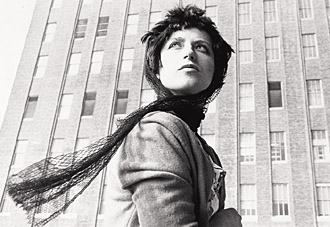
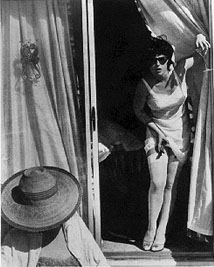
     The artist Cindy Sherman explores this celebrity from the female perspective, but she also tackles the issue of the objectification of women. Through recreating film stills, Sherman seeks to understand and create a commentary on female stereotyping in modern media. 


Some of her recreated film stills:

Another artist who works with film stills is John Stezaker, who creates collages with the stills in an effort to understand how photography affects different parts of the human psyche. His work dabbles in surrealism, and some of it can be seen as a bit off-putting and grotesque. It messes with the mind to see iconic figures reduced to fragments of what they once were, and that is exactly the reaction he aims for. 
Examples of his work: 


Monday, September 13, 2010

Digitizing the Runway

In the process of perusing clothing websites and style networks, I came across this dress: 
Dress by Mary Katranzou


     After poking around a bit more, I found a few more dresses of the same strange but beautiful material from the designer Basso and Brooke : 


     The blog that I found both dresses on mentioned "digital printing". Curious, I shot over to the New York Times and did a search. 
     Apparently, digital printing (in the fashion world) is a way of making textiles that gives one prints that can't be made anywhere else. Mary Katrantzou, the designer of the first dress, is apparently spearheading this new trend. The trend began in London, and is making its way into top designer lines such as Alexander McQueen for the spring 2011. The Times quoted Katrantzou as saying that although she was trained in traditional screen printing, there is "no limitation" when one is working on a textile digitally. It seems that design is radically changing the fashion field, whether it's due to the relative speed of computers to handmade patterns or the fact that thousands of colors and effects can be achieved with a computer. 
     Some designers are worried that this new way of making patterns takes some of the traditional magic out of the process, but have to admit that if it takes less time to make the clothing, it will cost less for the consumer and cause more people to  buy it. It's similar, as Susannah Hadley, a fabrics consultant for Louis Vuitton points out, to the argument in the 1800's that photography killed painting. You can only wait and see.

Buzzword! 
Server Farm: hundreds of thousands of pcs joined together to basically do the one task of providing service to the masses. 


Sunday, September 12, 2010

Design festivals everywhere!!

      The New York Times published an interesting article about design festivals across the globe, most notably in places such as Seoul, Amsterdam, and Paris. This week and the next is the beginning of a month or so of festivals dedicated to the design world. They cover various aspects of design, from landscaping and architecture to furniture and computer graphics. The festivals include shows, galleries, food, and all manner of impressive venues.
     The biggest splash will be made by the Seoul Design Fair, which had as many as two million people attend last year (I hope they've got good crowd control skills!). This year the show will be showcasing the beginnings of Seoul's new design district, crafted by the architect Zaha Hadid, famous for her work in Naples, Germany, and America.
     After reading all that stuff, I'd like to attend. It sounds really cool, particularly the Dutch Design Double, which will be showcasing glass works an intellectual discussion about design and where it's taking the world.


The start of the Seoul Design District

Buzzword!
DPI: Dots per inch.
Why is this relevant? It's used when referring to the resolution of a picture; the more DPI it has, the sharper and clearer the picture will be.

Saturday, September 11, 2010

Maybe you should study Engineering and Design...

     I've seen a lot of technological/design advances in the news, on blogs, facebook, etc. this week, and it occurred to me that designers, in addition to all of the other skills they need to have, are sometimes expected to be engineers as well. As the wired.com blog Beyond the Beyond shows, sometimes things generate a buzz just because they've combined some new technology with a flair for design and usefulness (say, as in designing a chair that folds and unfolds, like the proposed idea for Roombots). Most of the time it seems that designers draw up an idea and then go about finding technologically savvy people to help them put it together, or vice versa (engineers make something amazing that doesn't look so great and find designers to make it cool).
     The designer that has a good grasp on aesthetic beauty and creativity as well as the same technological ability of the engineers they're used to seeking out for projects such as these would be really popular.
     And really rich.

Buzzword!

Cloud computing : storing your information “in the cloud”, in a place that is accessible from different computers (like the internet!). It’s the opposite of simply storing something on your personal computer. A blog like this, for example, is simply me making notes that get stored on a public server. 

Sunday, September 5, 2010

Class Numero Uno!!

     I signed up for Graphic Design not only because it's required of a Fine Art major, but because I thought it would be interesting. From the first class, I'm guessing that it will be, even if it's looking like a LOT of work from this end.  If I survive it (lol) I'm reasonably certain I'll come out of the other end more skilled at networking, if nothing else.
     So far we've been introduced to the basic idea of what Design actually is, what it includes, who does it (people who are good at a variety of things and know a little bit about everything), how long it's been around (since the pyramids)... and the fact that you don't become a designer in three months. You just get a little less spastic with a mouse.
     Professor Klinkowstein mentioned that he is looking into creating a business and design joint major, and after hearing his presentation, I wonder why the idea hasn't occurred to Hofstra before now. A good designer sounds like a savvy businessman who happens to be a little more creative than his peers. The presentation included some networking skills like having an "elevator pitch" (something short about what you do that's hopefully more interesting than the muzak), and T-Shaped skills (basically being knowledgeable about several topics that you can apply to your specialty), which were all valuable business skills.
     They're also pretty valuable life skills.


Buzzword!
Ethnography - The study of small communities.
Why is this relevant?  In design, ethnography can be used to determine what the people want, crucial to keeping ahead of trends!

That is all.