Tuesday, September 21, 2010

Three Dimensions!

This week, the New York Times ran a story on the ways that three-dimensional printing is changing the manufacturing industry. This technology, which prints layer upon layer of plastic (stacking them to create one three dimensional object in the same way that one sticks post-its together to make a block) to make anything from prosthetic limbs to cellphone cases, has been around for a few years. It is, however, seeing advances that simplify it and make it even more accessible to the public, such as faster print speed and cheaper processing costs. The Times aptly puts it as "it is manufacturing with a mouse click instead of hammers, nails and well.. workers". 
     The creation of a printer that could cater to mass production needs could eliminate the need to outsource jobs, as things can be made in a designer's place of business and save them shipping time and costs.It also makes it easier for budding inventors to create prototypes of things that they wish to invent, and therefore test them before making them with more costly materials. 
     Already companies have begun to experiment with three-dimensional design as their main focus of operations. Freedom of Creation is one such company, and they create 3d printed jewelry, clothing, phone cases, perfume bottles, lamp shades, and anything else the client asks for. They even print furniture. The company is based in Helsinki, Finland and was one of the very first companies to consider three dimensional printing as a viable way of creating useful products. 
     The emergence of easier ways to use faster technology always bring us back to the question of what's being pushed out in favor of it. The point of the Times article, in addition to calling attention to the innovation of the thing, also brought attention to the idea that one needs less people to click a mouse than they do to cast a plastic mold. 

Stools from Freedom of Creation


Wednesday, September 15, 2010

Film Stills!

     Film stills are defined, by Wikipedia, as "photograph taken on the set of a movie or television program during production by a movie stills photographer, primarily used for promotional purposes". However, some artists use them for expressive purposes, as the basis of their works. They believe that film stills can be manipulated into becoming commentaries on things occurring in society. The artist usually does this by replacing the person in the film still with a photo of themselves, immediately injecting more meaning into it. No longer is the film still simply that of an actress or actor doing their job, but it is an average person taking their own shot at celebrity, at becoming someone else. 


     Celebrity is something that's been around for many years, beginning when people put extra emphasis on the status of gods, kings, and pharaohs. Celebrity, at its core, is really the widespread notoriety of a given person. It can come from a variety of things, including talent, fear mongering, or even idiocy (simply put, some people are famous because others like to make fun of them). Celebrity has fundamentally changed from the way it used to be to now in that we value different things. Our kings are now actors and actresses, athletes, and musicians. Being rich can earn celebrity, and being a wild child can earn it too.
Angelina Jolie, celebrity for her acting skill
Paris Hilton, a celebrity because she has a lot of money and parties hard. 


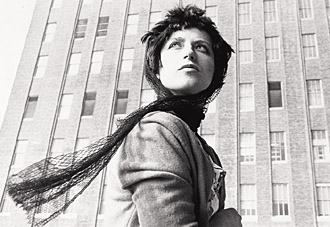
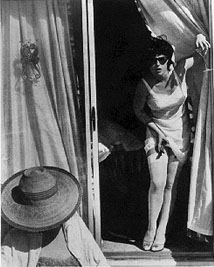
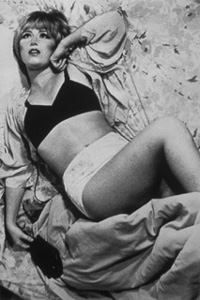
     The artist Cindy Sherman explores this celebrity from the female perspective, but she also tackles the issue of the objectification of women. Through recreating film stills, Sherman seeks to understand and create a commentary on female stereotyping in modern media. 


Some of her recreated film stills:

Another artist who works with film stills is John Stezaker, who creates collages with the stills in an effort to understand how photography affects different parts of the human psyche. His work dabbles in surrealism, and some of it can be seen as a bit off-putting and grotesque. It messes with the mind to see iconic figures reduced to fragments of what they once were, and that is exactly the reaction he aims for. 
Examples of his work: 


Monday, September 13, 2010

Digitizing the Runway

In the process of perusing clothing websites and style networks, I came across this dress: 
Dress by Mary Katranzou


     After poking around a bit more, I found a few more dresses of the same strange but beautiful material from the designer Basso and Brooke : 


     The blog that I found both dresses on mentioned "digital printing". Curious, I shot over to the New York Times and did a search. 
     Apparently, digital printing (in the fashion world) is a way of making textiles that gives one prints that can't be made anywhere else. Mary Katrantzou, the designer of the first dress, is apparently spearheading this new trend. The trend began in London, and is making its way into top designer lines such as Alexander McQueen for the spring 2011. The Times quoted Katrantzou as saying that although she was trained in traditional screen printing, there is "no limitation" when one is working on a textile digitally. It seems that design is radically changing the fashion field, whether it's due to the relative speed of computers to handmade patterns or the fact that thousands of colors and effects can be achieved with a computer. 
     Some designers are worried that this new way of making patterns takes some of the traditional magic out of the process, but have to admit that if it takes less time to make the clothing, it will cost less for the consumer and cause more people to  buy it. It's similar, as Susannah Hadley, a fabrics consultant for Louis Vuitton points out, to the argument in the 1800's that photography killed painting. You can only wait and see.

Buzzword! 
Server Farm: hundreds of thousands of pcs joined together to basically do the one task of providing service to the masses. 


Sunday, September 12, 2010

Design festivals everywhere!!

      The New York Times published an interesting article about design festivals across the globe, most notably in places such as Seoul, Amsterdam, and Paris. This week and the next is the beginning of a month or so of festivals dedicated to the design world. They cover various aspects of design, from landscaping and architecture to furniture and computer graphics. The festivals include shows, galleries, food, and all manner of impressive venues.
     The biggest splash will be made by the Seoul Design Fair, which had as many as two million people attend last year (I hope they've got good crowd control skills!). This year the show will be showcasing the beginnings of Seoul's new design district, crafted by the architect Zaha Hadid, famous for her work in Naples, Germany, and America.
     After reading all that stuff, I'd like to attend. It sounds really cool, particularly the Dutch Design Double, which will be showcasing glass works an intellectual discussion about design and where it's taking the world.


The start of the Seoul Design District

Buzzword!
DPI: Dots per inch.
Why is this relevant? It's used when referring to the resolution of a picture; the more DPI it has, the sharper and clearer the picture will be.

Saturday, September 11, 2010

Maybe you should study Engineering and Design...

     I've seen a lot of technological/design advances in the news, on blogs, facebook, etc. this week, and it occurred to me that designers, in addition to all of the other skills they need to have, are sometimes expected to be engineers as well. As the wired.com blog Beyond the Beyond shows, sometimes things generate a buzz just because they've combined some new technology with a flair for design and usefulness (say, as in designing a chair that folds and unfolds, like the proposed idea for Roombots). Most of the time it seems that designers draw up an idea and then go about finding technologically savvy people to help them put it together, or vice versa (engineers make something amazing that doesn't look so great and find designers to make it cool).
     The designer that has a good grasp on aesthetic beauty and creativity as well as the same technological ability of the engineers they're used to seeking out for projects such as these would be really popular.
     And really rich.

Buzzword!

Cloud computing : storing your information “in the cloud”, in a place that is accessible from different computers (like the internet!). It’s the opposite of simply storing something on your personal computer. A blog like this, for example, is simply me making notes that get stored on a public server. 

Sunday, September 5, 2010

Class Numero Uno!!

     I signed up for Graphic Design not only because it's required of a Fine Art major, but because I thought it would be interesting. From the first class, I'm guessing that it will be, even if it's looking like a LOT of work from this end.  If I survive it (lol) I'm reasonably certain I'll come out of the other end more skilled at networking, if nothing else.
     So far we've been introduced to the basic idea of what Design actually is, what it includes, who does it (people who are good at a variety of things and know a little bit about everything), how long it's been around (since the pyramids)... and the fact that you don't become a designer in three months. You just get a little less spastic with a mouse.
     Professor Klinkowstein mentioned that he is looking into creating a business and design joint major, and after hearing his presentation, I wonder why the idea hasn't occurred to Hofstra before now. A good designer sounds like a savvy businessman who happens to be a little more creative than his peers. The presentation included some networking skills like having an "elevator pitch" (something short about what you do that's hopefully more interesting than the muzak), and T-Shaped skills (basically being knowledgeable about several topics that you can apply to your specialty), which were all valuable business skills.
     They're also pretty valuable life skills.


Buzzword!
Ethnography - The study of small communities.
Why is this relevant?  In design, ethnography can be used to determine what the people want, crucial to keeping ahead of trends!

That is all.